
The "Joke" Patent Application
US Application No. 10/569,506 (2004)

Get ready to be mildly amused.
For April Fools’ Day, rather than trying to prank our fledgling readership with a satirical IP blog post that only patent nerds could possibly find funny, we’re instead going to stick to a factual account of a real historical patent application. The good news is: we’ve found a patent application that is itself a satirical IP joke that only patent nerds could possibly find funny.
This week, we’re featuring US Application No. 10/569,506 (the ’506 Application), Business method protecting jokes, filed in 2004.
Buckle up.
The Abstract
The Abstract of the ’506 Application explains up front that this patent application seeks to protect jokes. Furthermore, the self-referential nature of the ’506 Application is also immediately apparent, with the Abstract explaining that the method for which patent protection is sought actually involves filing a patent application:
The specification describes a method of protecting jokes by filing patent applications therefor, and gives examples of novel jokes to be thus protected. Specific jokes to be protected by the process of the invention include stories about animals playing ball-games, in which alliteration is used in the punch-line; a scheme for raising money for charity by providing dogs for carriage by Underground passengers; and the joke that consists in filing a patent application to protect jokes. A novel type of patent application, one that claims itself, and hence is termed ‘homoproprietary’, is disclosed.
If you are not a patent nerd and you’ve already lost (a) the thread or (b) all interest, I am not surprised. This is distilled, weapons-grade wonk humor that starts from the same sort insider-appeal humor proposition as a Law Revue parody music video and then asks: “What if the joke appealed to even fewer people?” Alas, here we are, and continue we must.
The Specification
The ’506 Application presses on, taking the time to explain in its background section that US patent law, at the time of filing of the application in the early 2000s, permitted certain business methods patents under the recent State Street Bank Federal Circuit decision in 1998 (Bilski and Alice were still years away).
With regard to patent eligibility of a business method for protecting a joke in Europe, the ’506 Application notes that “most forms of medicine can be protected by patent applications in most countries.” Thus, the ’506 Application reasons: “As the old saying goes: ‘Laughter is the best medicine’. Protection should be available for this medicine also.” An unassailable legal theory.
The body of the specification notes several key features of the purported invention:
“An essential feature of the invention is the filing of a patent application characterising the novel joke, defining the novel feature, or combination of features, thereof. It is preferred to prosecute the patent application at least to publication, and if possible to grant.” (Paragraph [0015].)
“Jokes according to the invention may be recited or (in some cases) rehearsed. … Practical jokes are intended for reproduction by rehearsal, but may also be exploited by recounting them (this will usually be more convenient, if less funny).” (Paragraph [0017].)
“All kinds of jokes may be protected by the process of the present invention. The joke may be completely new … . It may be an improvement or embellishment or adaptation, e.g. updating, of a known joke type. It may take the form of an anecdote, a pun, a wisecrack, irony, a shaggy dog story, a cartoon.” (Paragraph [0020].)
“It is an additional feature of the invention to file patent applications protecting jokes on 1 April. In many countries, the first day of April is recognised as a day for performing practical jokes, and accordingly it may be regarded as particularly fitting to file patent applications protecting jokes on 1 April.” (Paragraph [0024].)
The Examples
The specification then recites seven “Examples,” each of which sets out a joke that may constitute the invention or be may protected by the method of the claimed invention:
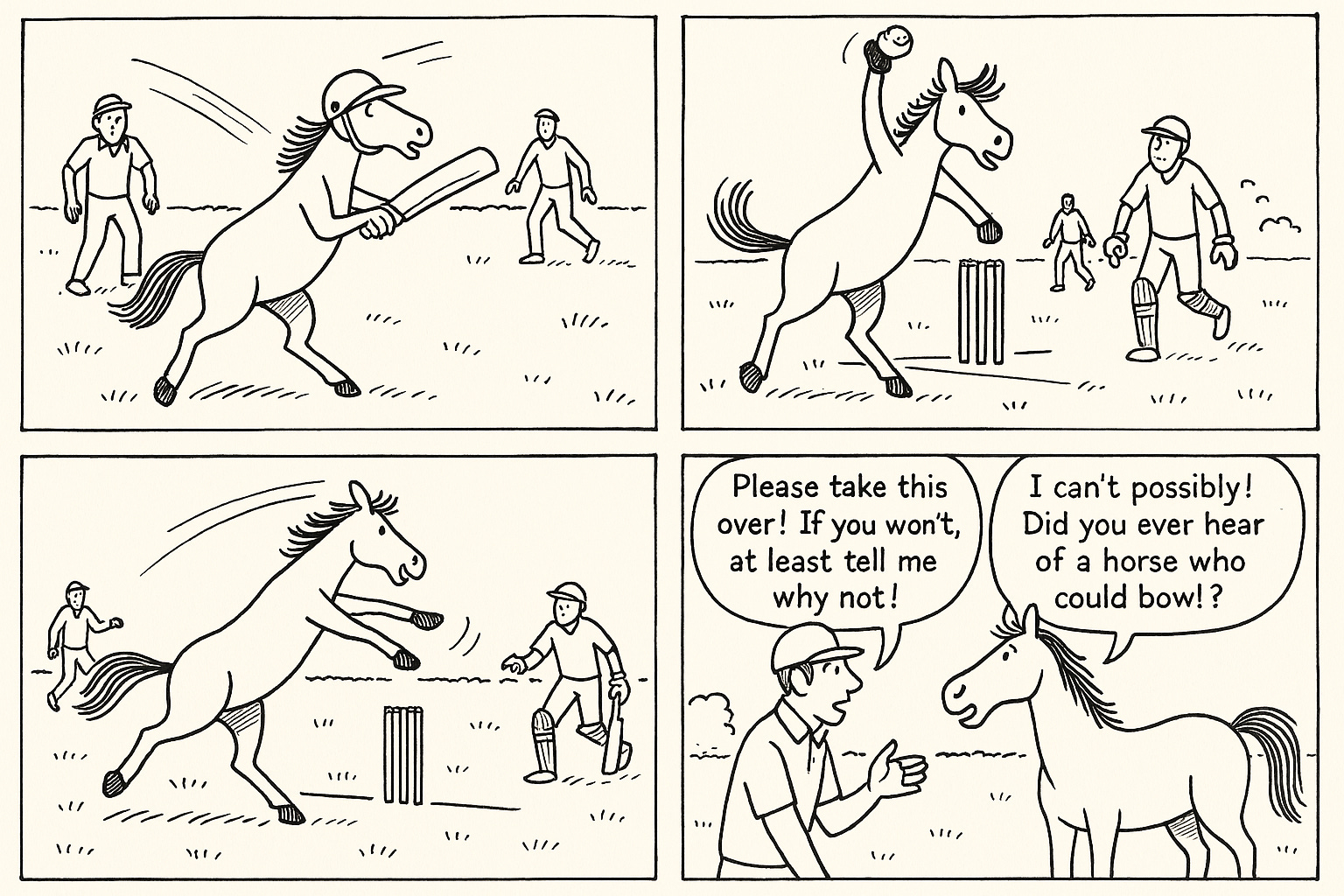
Example 1: A “shaggy dog story” in which a horse plays cricket.
Example 2: “A UK patent application for an invention accompanied by a specification describing the joke of Example 1.”
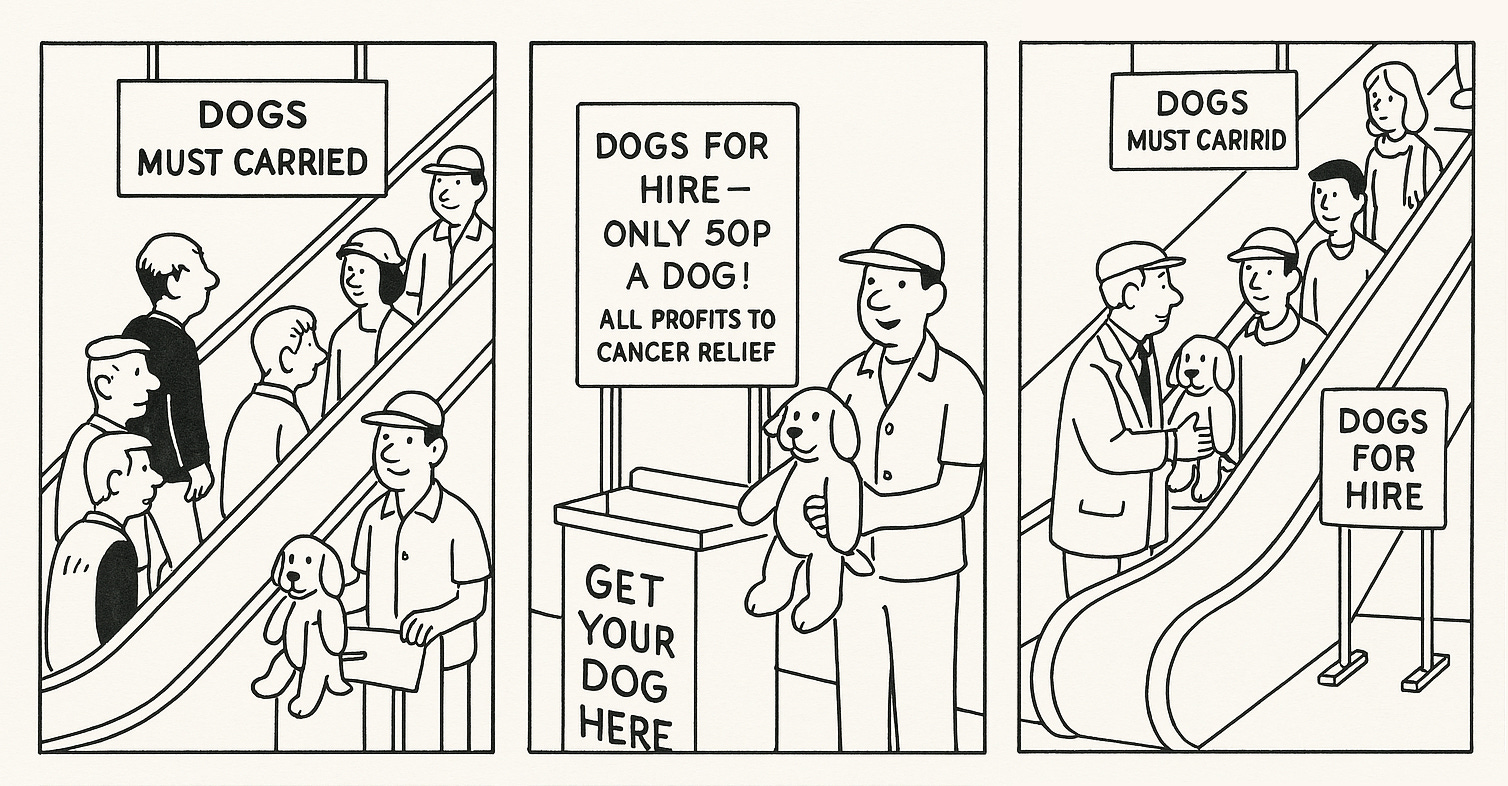
Example 3: A practical joke poking fun at London Underground signs reading “Dogs must be carried.” Pranksters stand beside the signs and hold their own signs offering to lend out dogs for passengers to carry.
Example 4: “A UK patent application for the invention, accompanied by a specification describing (inter alia) the joke of Example 3.”
Example 5: A “self-referential” practical joke that “consists in the filing of a patent application to protect the method of protecting jokes by filing one or more patent applications thereon.”
Example 6: “A patent application describing and claiming the jokes set out herein in Examples 1-7 was filed at the UK Patent Office on 1 Apr. 2004.”
Example 7: A “homoproprietary” patent application that claims itself.
The Examples section of the patent application does a few things.
Primarily, it beats a dead horse by belaboring the joke itself for about three iterations too many. But, while I felt the humor dragged a bit through examples 4-6, the following dry quip in Example 7, in the final paragraph of the specification, somehow reeled me back in: “Note that the concept of a homoproprietary patent application is intrinsically comic.”
I also commend the patent applicant for using Examples 1 and 3 to make the jump from industry-insider wonky satire into downright peddling his own personal jokes. Regarding Example 3 in particular — the one making fun of the grammatical ambiguity of the London Underground “Dogs must be carried” signs — I’m for some reason almost certain that this was a standby favorite bit of the applicant here, one which he surely repeated to semi-willing family and friends for years before choosing to immortalize it in this patent application. Notably, the applicant appears not to be alone in poking fun at the poorly-worded signs: about eleven years after the ’506 Application was first filed, the Paddington movie included a scene featuring the “dogs must be carried” signs as the setup for a joke.
The (lack of) Drawings
Sadly, this patent application was filed without any drawings. Perhaps the applicant was in a rush to get the application filed on exactly April 1, and didn’t have time to work with an illustrator to prepare drawings.
Luckily, in 2025, we have the magic of Generative AI, so here is an illustration of Example 3 — the one about the cricketer horse.
And here is an illustration of Example 5 — the one about carrying dogs.
The Claims
If you’re (somehow) still reading at this point, I think you thoroughly understand the bit by now, so I’ll just highlight the originally-filed independent claims, and we can move on and wrap this up.
The process of protecting a novel joke which comprises filing a patent application defining the novel features of the joke.
A joke relating to the unexpected but partial skill of animals (preferably large mammals or birds) in sports involving spheroidal projectiles, characterised in that the punch-line employs alliteration.
In a locus in which the behaviour of the public is subject to a promulgated rule intended to be conditional, the joke which comprises misinterpreting the rule as absolute, and providing means for enabling the public to conform to the rule so misinterpreted.
The joke which comprises the filing of a patent application to protect the method of protecting jokes by filing one or more patent applications thereon.
A homoproprietary patent application or patent.
The Filing Strategy
Perhaps the most shocking thing about this patent application is not just that the applicant drafted out the entire application (again, before the age of generative AI), but that he paid to file it in not one but four jurisdictions. The US application is the headliner in this blog post due to our own regional bias, but protection for this “invention” was also sought in the UK and Australia, with a PCT application used to facilitate foreign filing.
The original application was actually a UK application filed in 2003, which makes sense, because the “inventor” behind this patent application, Timothy Wace Roberts, was a British patent attorney and two-time president of The Chartered Institute of Patent Attorneys, the official British professional body of patent attorneys.
I haven’t looked up what the fee schedules were 20 years ago, but this set of filings could easily have cost more than $5,000 just in filing fees. Perhaps Roberts crowdsourced this undertaking amongst friends or colleagues who shared his sense of humor.
The US Examination
Unsurprisingly, this “invention” does not appear to have been granted patent protection in any of the three jurisdictions where it was substantively pursued. This, despite the specification’s well-reasoned theory that joke patents are really just a form of patent-eligible methods-of-medical-treatment patents.
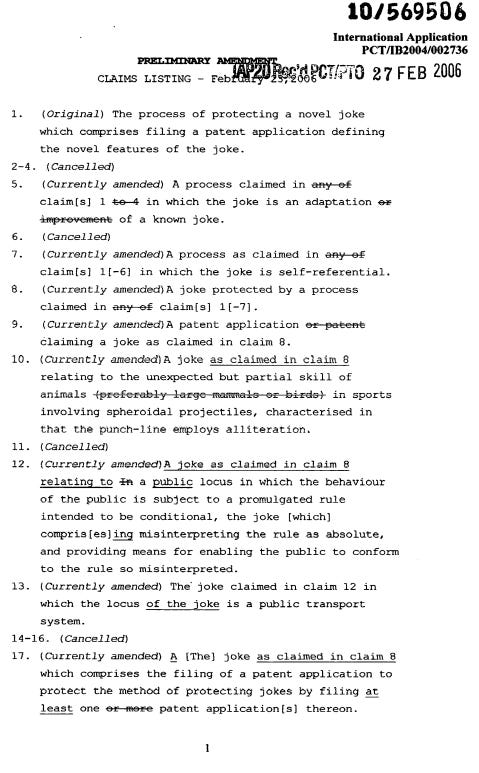
In the ’506 Application in the US, the application entered prosecution as a national stage application via the PCT, and the applicant actually filed a preliminary claim amendment in 2006, three years after the original UK filing. The amendments make a colorable effort at placing the claims in condition more suitable for US patent practice, such as by eliminating multiple dependencies and optional recitations.
When it finally came time for an examiner to review the ’506 Application in June 2008, the task fell to Examiner Jacob C. Coppola, who did a very thorough job of setting forth a laundry list of rejections:
Rejections under section §101 for lacking utility;
Rejections under section §101 for not falling within a statutory class;
Rejections under section §101 for printed matter;
Rejections under section §112, first paragraph, for lacking enabling disclosure;
Rejections under section §112, second paragraph, for indefiniteness;
Rejections under section §102 and §103 for anticipation and obviousness over applicant-admitted prior art
For a thorough breakdown of the Examiner Coppola’s rejection of the ’506 Application, you can check out this writeup from another patent blog ten years ago today. And, note that Examiner Coppola still works at the USPTO today in art group 3620 (Business Methods), having examined nearly 800 patent applications over the last 18 years!
Sadly, the journey of the ’506 Application came to an end following Examiner Coppola’s thorough rejection, as the applicant did not respond to the initial office action and the ’506 Application was deemed abandoned in December 2008.
Final Thoughts
Given this patent application was filed and prosecuted shortly before the advent of widespread social media, it’s not entirely surprising that there doesn’t seem to be a lot of information available on the internet as to — well — what this was all really about.
One reading is that Roberts was trying to make something of a point about policy regarding business methods patents. The background section of the ’506 Application includes this passage in paragraph [0015], which might be read as Roberts nodding toward his views on an area of patent law that was contested and evolving at the time.
Filing of a patent application constitutes a claim to exclusive rights, and such rights may be licensed even if not certainly valid. At the time of writing, patents for inventions relating to ‘business methods’ may be granted by the US Patent Office, the Australian Patent Office and probably by other Patent Offices, for example the Japanese Patent Office. They are typically refused by the European Patent Office. However, it is quite possible that this illiberal practice will change: as noted above, the tendency, in the European Patent Office and elsewhere, is continually to widen the categories of patentability. Thus, applications according to the invention may be filed in countries where the law is currently unfavourable: even if the law has not changed, they may benefit from the expectation that it will change, or even the possibility that it could. And in many countries the examination of patents is quite slow. A patent application may be kept pending for a number of years while all possibilities of appeal, divisional filings, continuations, etc., are exhausted. Competitors have to consider, not only what the law is, but what it might become. And potential infringers need to consider the inconvenience and expense of being sued, even if assured by credible legal advice that they will ultimately win.
It’s certainly plausible that Roberts, being involved in a leadership position in a professional patent attorneys association, would have been the kind of person who would have wanted to foster discussion of policy issues on patent law. Moreover, the 2015 blog writeup that I linked above also says that Roberts told an interviewer that his application was filed “to test the bounds of patentability around the world.” But, I can’t find any other record of that interview. Perhaps it’s on a microfiche somewhere deep in the subbasement of a university library.
Another, perhaps more charming reading of the ’506 Application and its family members is that Roberts simply decided, for the sake of good humor, to spend a fair amount of his own time and money giving life to a pretty ridiculous and incredibly narrowly-targeted satirical comical bit. One that I am now, in spite of myself, appreciating some 22 years later.
In either event, happy April Fools’ Day!
What I want to know is how you guys found this patent? Great post for April Fools’ Day!