
The Lightsaber Patent
US 10,065,127 (2018)


In honor of Star Wars Day, let’s take a look at the iconic lightsaber, a sword-like energy weapon from a galaxy far, far away. The lightsaber’s glowing deadly blade emerges from a cylindrical hilt and can slice effortlessly through just about anything – metal blast doors, enemy droids, or hostile aliens you might encounter at a cantina.
In the original 1977 Star Wars film, vintage Graflex camera flash handles were used as lightsaber hilts, and rigid rods covered in retroreflective material were used to simulate glowing lightsaber blades.
Toy and replica lightsabers then abounded.
In the 80s and 90s, it was essentially mandatory for young kids to own a toy plastic lightsaber with telescoping plastic tubes that allowed a hollow plastic “blade” to extend and retract. These were essentially flashlights in a hilt with nested plastic tubes that flicked open to form a chunky, segmented looking blade.
As those 80s and 90s kids grew up, they stepped up their game and turned to more polished lightsaber replicas, with higher-end rigid glowing blades that looked nice but, unfortunately, did not telescope in and out of the hilt.
At the extreme end of the technological complexity spectrum, there is also one guy who built a handheld 4000° plasma torch in essentially the form factor of a lightsaber. Wildly cool, but perhaps a bit much.
Still, the sweet spot remained elusive: a realistic lightsaber hilt with a smooth, thin, glowing blade that could emerge from and retract completely into the hilt. Finally, in 2023, Disney unveiled just such a lightsaber:
And behind that lightsaber, with its impressive blade extension and retraction effect, was U.S. Patent No. 10,065,127, titled “Sword Device with Retractable, Internally Illuminated Blade.” Let’s take a look at the patent to learn a bit about the clever engineering that powers this impressive device.
Inside Disney’s Lightsaber Patent: How It Works
So, what exactly is the magic inside the extendable and retractable lightsaber of the ’127 Patent? You might be surprised to learn it’s less “kyber crystal” (that’s for my fellow Star Wars nerds) and more “tape measure.” I’ll explain.
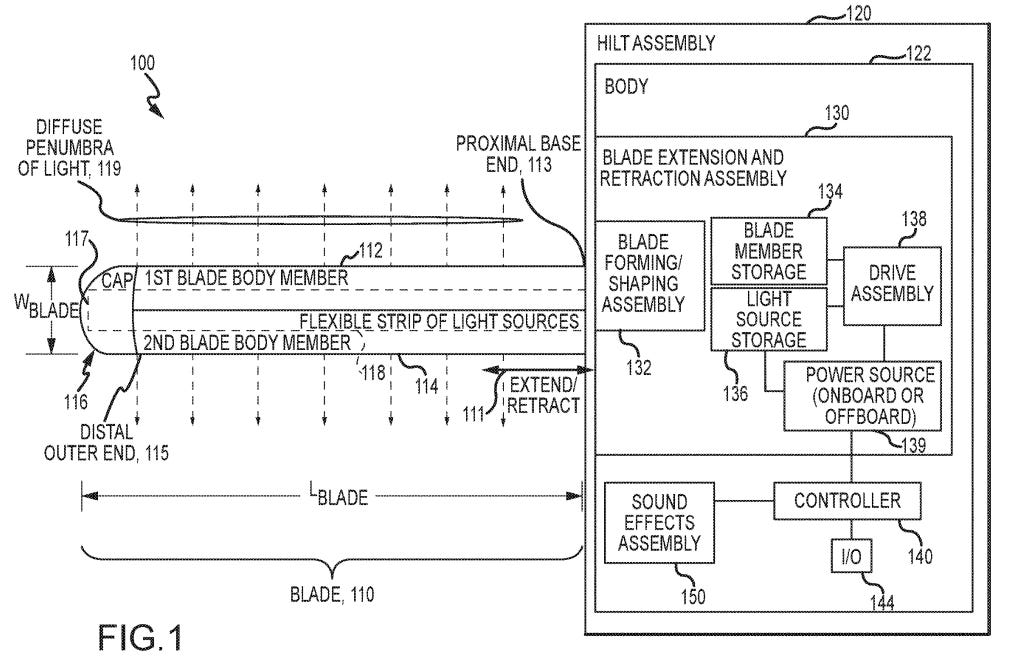
The ’127 Patent sets out that the lightsaber blade is made of two translucent flexible strips of plastic. Each of these strips has a semi-circular cross-sectional shape, forming one half of the cylindrical blade. So, while flick-open plastic toys in the 90s had blades made of several nested, telescoping cylindrical pieces that divided the blade up into lengthwise segments, the ’127 Patent relies on exactly two halfpipe-shaped strips that each run along the entire length of the blade, each forming half of the blade as divided along a center line. Below in FIG. 1 of the patent, the semi-circular strips are shown as “1st blade body member 112” and “2nd blade body member 114.”
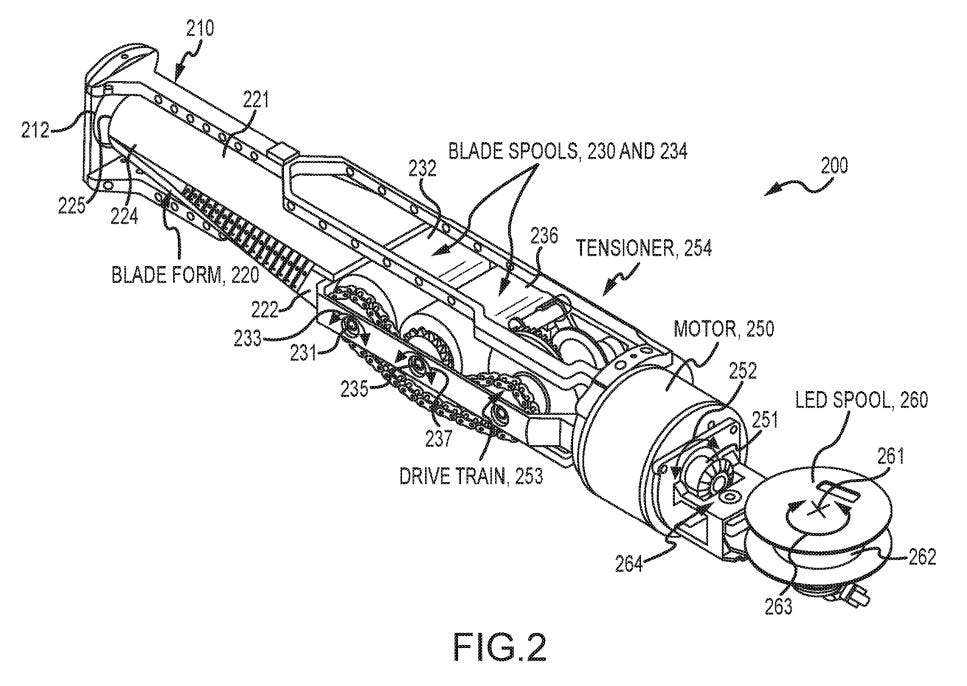
But the really clever aspect of this design is that each of these halfpipe-shaped blade halves can be retracted entirely into the hilt. The key is that the plastic strips are halfpipe-shaped when the blade is in the extended position, but that they flatten into a flat cross-sectional shape and can then spool up into a compact arrangement inside the hilt to draw the blade into the retracted position. Below, FIG. 2 of the patent shows “blade spools 230 and 240,” where the flexible blade segments are flattened into flat cross-sectional shapes and then wound into compact spools inside the hilt of the device.
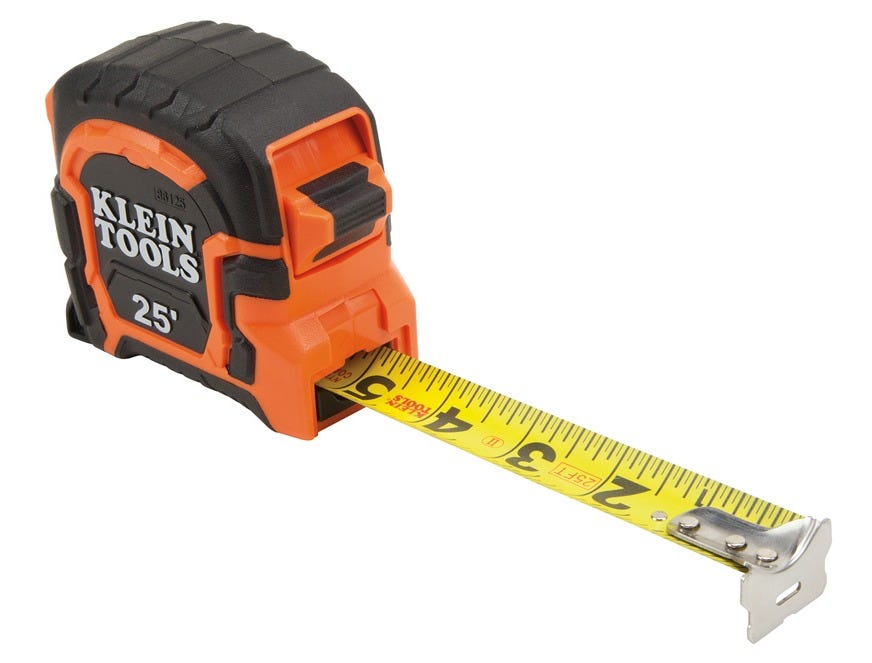
If you’re having trouble envisioning this, think about the shape of a metal tape measure when extended. The tape measure’s cross-sectional curvature (not quite semi-circular, but the principle is the same) helps stiffen the tape measure to allow it to hold its linear shape when extended. Then, when the tape measure is retracted back inside the case, the tape measure flattens out to allow for more compact spooling. The lightsaber blade of the ’127 Patent is essentially made of two extended “tape measures” whose concave surfaces face one another to form a cylinder.
This is also the same principle of operation as a slap bracelet (since I suppose we’re just going really hard on all of the nostalgia today), which has a curved cross-sectional shape when extended into the straight position, and which assumes a flat cross-sectional shape and a curls into a sort of “spool” along its length when slapped onto your wrist.
Leveraging the clever “double-tape-measure” blade effect, the ’127 Patent completes its lightsaber effect by attaching the end of the two blade segments to an endcap, motorizing the spools in the hilt so that the blade can smoothly extend and retract on its own (no “flick” required), and attaching a flexible and retractable LED strip to the underside of the endcap so that the blade glows from the inside when in the extended position.
Bringing the Lightsaber to Life
The patent is one thing, but seeing the device in action is another. After filing its patent application in 2018, Disney remained secretive, but rumors of the new device began to circulate among fans. In early 2021, Disney teased the retractable lightsaber in a closed-door presentation, sending fans into a frenzy, but still did not publicly demonstrate the new device. Disney then announced that the retractable lightsaber would be part of the shows at its Galactic Starcruiser hotel experience. Finally, at South by Southwest in 2023, the public got a full demo of the “real” lightsaber with the design from the ’127 Patent, its neon blade appearing suddenly from a compact, handheld hilt.
The hype was real, and the wait was worth it.
So, can you get your hands on one of these awesome lightsaber props? For now, it appears the devices are used by Disney performers only, and are not sold to fans. We can’t speculate as to Disney’s future business plans, but it’s probably safe to say that demand would be through the roof if a consumer version ever appears.
Even if we can’t play with the ’127 lightsaber ourselves, we can still appreciate the clever design of the ’127 Patent, which simply puts to shame the telescoping plastic toys of the 80s and 90s and the fixed-blade replicas of the 2010s. “An elegant weapon of a more civilized age,” if you will.
Until next year, May the Fourth be with you.